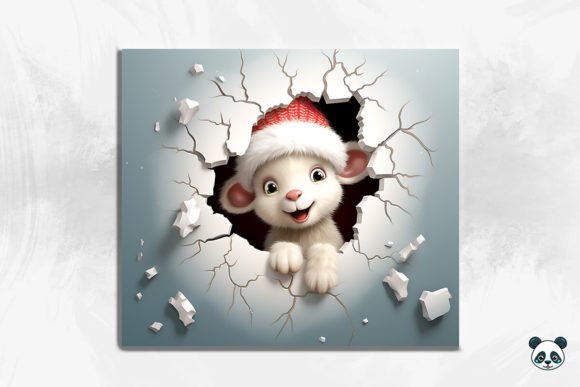
Integrating 3D Lamb Tumbler Wrap Sublimation 1 into Your Production Workflow
In the competitive landscape of custom merchandise, the difference between a hobbyist operation and a scalable small business often lies in the efficiency of the design-to-production pipeline. For creators specializing in drinkware, the 3D Lamb Tumbler Wrap Sublimation 1 represents more than just a digital asset; it is a foundational component of a streamlined manufacturing process. This specific design, featuring a high-resolution 3D lamb motif with watercolor elements, serves as a critical input for producing 20 oz skinny tumblers. Understanding how to integrate this instant digital download into your broader operational workflow is essential for maintaining consistency, reducing waste, and maximizing output quality.
The modern sublimation entrepreneur does not simply print images; they manage a sequence of interdependent tasks involving file management, hardware calibration, material selection, and quality control. The 3D Lamb Tumbler Wrap Sublimation 1 fits into this ecosystem as a pre-validated resource that eliminates the time-consuming stages of initial illustration and pattern creation. By utilizing a professionally prepared PNG file sized at 9.3 inches by 8.2 inches at 300 DPI, you bypass the need for vector tracing or raster manipulation, allowing you to focus on the execution phases of your business.
Pre-Production Planning and File Integration
Before any heat is applied or ink is sprayed, the workflow begins with digital organization. Upon purchasing and downloading the ZIP file containing the 3D Lamb Tumbler Wrap Sublimation 1, the immediate task is asset verification. Unlike generic clip art, this file is specifically engineered for the dimensions of a 20 oz skinny tumbler. The 9.3 x 8.2 inch specification is not arbitrary; it accounts for the circumference and height of standard straight tumblers, ensuring that the seamless pattern aligns correctly without awkward gaps or overlapping seams that disrupt the visual continuity of the 3D lamb design.
Effective integration requires compatibility checks with your current design software. Whether you are using Adobe Photoshop, Illustrator, Canva, or specialized sublimation RIP software, importing this PNG should be a frictionless step. Because the file is provided at 300 DPI, it meets the industry standard for high-quality printing. Lower resolution files often result in pixelation when stretched to fit large surfaces, but this asset maintains clarity even under close inspection. During the planning phase, you should also consider how this design interacts with your inventory. The "Lamb" theme suggests seasonal viability, particularly for spring collections or Easter promotions, but the neutral watercolor background allows it to function as a year-round staple for farm-themed or nursery-oriented product lines.
Organization is key to long-term efficiency. Instead of leaving the file in a temporary download folder, establish a structured directory system. Categorize the 3D Lamb Tumbler Wrap Sublimation 1 under specific tags such as "Animal Themes," "Skinny Tumbler Ready," or "Q1 Inventory." This practice ensures that when a client requests a custom order or when you are batching products for an upcoming craft fair, you can retrieve the asset instantly. This reduces decision fatigue and keeps the production line moving.
Execution: From Digital File to Physical Product
Once the file is organized and the order is queued, the workflow shifts to the physical execution stage. This is where the theoretical compatibility of the digital file meets the reality of sublimation physics. The 3D Lamb Tumbler Wrap Sublimation 1 is designed to be printed onto sublimation paper using dye-sublimation inks. It is crucial to remember that this item is a digital file only; no physical wraps are included. Therefore, the quality of the final output depends heavily on your printer settings and paper choice.
To achieve the vibrant colors seen in the 3D design, your printer profile must be calibrated for the specific paper brand you are using. Since the design features a "3D background" and watercolor textures, color accuracy is paramount. A misaligned color profile could mute the soft blues and greens of the watercolor or distort the depth of the 3D lamb illustration. Before committing to a full production run, always print a test strip. This allows you to verify that the gradient transitions in the background are smooth and that the white points in the image remain crisp, as sublimation cannot print white ink—it relies on the white coating of the tumbler to provide brightness.
After printing, the wrapping process requires precision. The 9.3-inch width of the design is intended to wrap around the 20 oz skinny tumbler with a slight overlap or a butt joint, depending on your preferred finishing method. Using heat-resistant tape, secure the sublimation paper tightly against the tumbler surface. Any air bubbles or loose sections will result in ghosting or blurred areas in the final image, ruining the 3D effect. The seamless nature of the pattern means that if the alignment is off by even a few millimeters, the break in the pattern will be visible. Careful tensioning of the paper ensures the Lamb seamless pattern flows uninterrupted around the cylinder.
Quality Control and Post-Processing
The heating phase is the transformative moment in the workflow. Placing the wrapped tumbler into a convection oven or a dedicated skinny tumbler press requires adherence to specific time and temperature protocols. While the 3D Lamb Tumbler Wrap Sublimation 1 provides the visual data, the heat press provides the chemical bond. Deviating from recommended settings can lead to under-saturation (faded colors) or over-baking (yellowing of the white background). Consistency here is vital for professional results.
Post-processing involves cooling and inspection. Once the tumbler has cooled and the paper is removed, a rigorous quality control check is necessary. Examine the wrap for any streaks, spots, or misalignments. The 3D elements of the lamb should appear to pop off the surface, and the watercolor background should look fluid and natural. If the product passes inspection, it moves to packaging. If it fails, the root cause must be identified immediately—was it the printer nozzle, the paper placement, or the heat cycle? This feedback loop is essential for refining your process and minimizing future waste.
Strategic Application in Business Workflows
Beyond the technical mechanics, the 3D Lamb Tumbler Wrap Sublimation 1 plays a strategic role in business scalability. For marketers and content creators, having a library of high-quality, ready-to-use designs accelerates time-to-market. You can photograph the finished product for social media campaigns, list it on e-commerce platforms like Etsy or Shopify, and fulfill orders rapidly because the design phase is already complete. This asset supports a "print-on-demand" model where inventory risk is low, as you only produce what is sold.
Furthermore, this design can be part of a larger collection strategy. By pairing the lamb wrap with complementary designs—perhaps a matching coaster set or a different animal in the same 3D watercolor style—you create cohesive product bundles that increase average order value. The versatility of the Lamb png and its seamless pattern also allows for adaptation. While optimized for 20 oz skinny tumblers, skilled operators can scale or crop the image for other substrates like mousepads or tote bags, provided the resolution remains sufficient for the new dimensions.
Ultimately, the value of this digital download lies in its ability to simplify complex creative workflows. It removes the barrier of artistic skill for those who excel in production but struggle with illustration, and it saves time for professional designers who need reliable base layers for customization. By treating the 3D Lamb Tumbler Wrap Sublimation 1 as a integral cog in your operational machine rather than just a pretty picture, you enhance your capacity to deliver high-quality, consistent products to your customers. The transition from a raw digital file to a finished, revenue-generating product is smoothest when every step—from download to delivery—is planned, executed, and reviewed with precision.